Walk down Paisley High Street on a Tuesday afternoon and count the shuttered shopfronts.
Count the “To Let” signs that have been there so long they’ve faded. Count the premises that used to be independent shops and are now bookies, vape stores, or simply empty. Then look up — past the shutters — and notice the architecture. The carved sandstone. The Victorian grandeur. The bones of a town that was once one of the most prosperous in Scotland.
Paisley made thread that was sold around the world. The Paisley Pattern is one of the most recognised textile designs in history. Coats, Clark, and the thread mills built a town of ambition and industry. That spirit hasn’t gone anywhere. It’s just been let down by decades of managed decline.
I’m standing for Paisley because I believe this town can be great again — not through another consultancy report or regeneration strategy document that sits on a shelf, but through practical, pro-enterprise policies that let people create, build, and trade.
What’s Actually Killing the High Street
Politicians love to blame online shopping for the death of the high street. It’s a convenient excuse because it requires no accountability. But talk to the business owners who are still here — the ones hanging on — and they’ll tell you the real problems:
Business rates are punitive. A small retailer on the high street pays rates that make the margins almost impossible. The system punishes physical presence and rewards online-only operators who have no shopfront, no staff, and no connection to the community.
Planning is glacial. Want to convert an empty office above a shop into a flat? That’s months of paperwork, consultations, and delays. Want to change a premises from retail to hospitality? More months. The planning system was designed for a different era and it’s strangling adaptation.
Footfall has no reason to come. Without a mix of independent retail, food and drink, services, and cultural activity, there’s no reason for people to choose the town centre over a retail park or Amazon. Footfall doesn’t appear by magic — it has to be generated.
Support is fragmented. There are grants, schemes, and initiatives available, but finding them, applying for them, and navigating the bureaucracy requires time that small business owners don’t have.
These are fixable problems. Every single one.
The Enterprise Zone
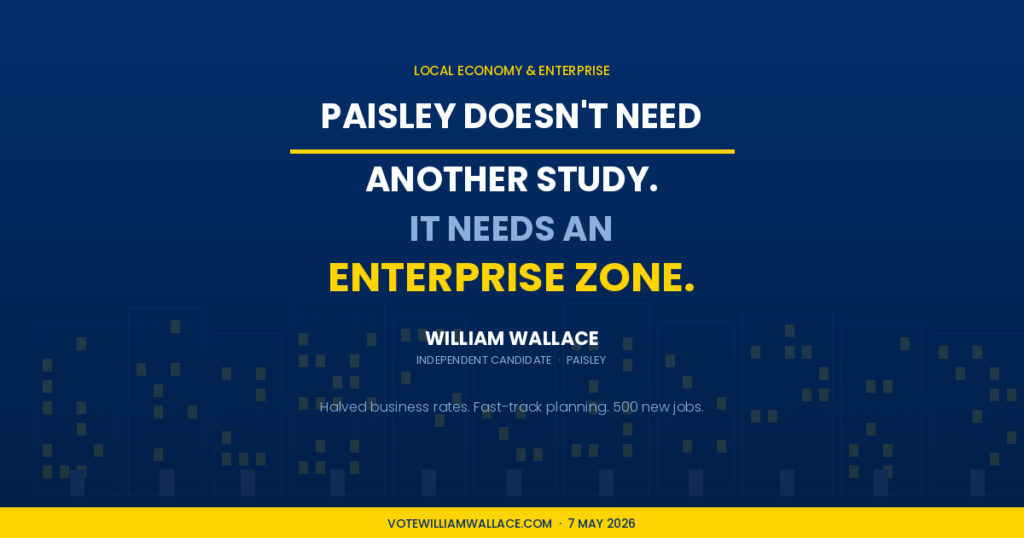
My first pledge is to campaign for Paisley to be designated as an Enterprise Zone. Here’s what that means in practice:
Halved business rates for five years. A new business opening on the high street would pay 50% of the standard rate for its first five years. An existing business that expands — takes on an extra unit, hires more staff — gets the same deal. This makes the maths work for businesses that are currently on the edge.
Fast-track planning. Applications for change of use, shopfront alterations, and conversion of upper floors should be decided in weeks, not months. A streamlined process with a single point of contact for business owners, not a maze of departments.
A start-up hub and co-working space. Paisley needs a physical space where freelancers, micro-businesses, and early-stage start-ups can work, network, and access support. This doesn’t need to be a flashy tech incubator — it needs to be affordable, practical, and in the town centre where it drives footfall.
A mentoring network. I’ve built a business from nothing. I know other entrepreneurs who have done the same. I will establish a volunteer mentoring programme connecting established business owners with new founders in Paisley. Free. Practical. No consultancy jargon.
Tourism: The Overlooked Opportunity
Scotland’s outdoor tourism sector is booming. As the founder of Wallace Campers, I see this first-hand — people are choosing Scotland for campervans, hiking, cycling, and coastal adventures. The visitor economy is growing and Paisley is perfectly positioned to benefit.
The town has Paisley Abbey, one of the finest medieval churches in Scotland. It has the soon-to-reopen Paisley Museum, a world-class collection in a stunning building. It has the Paisley Pattern, a globally recognised brand. And it sits ten minutes by train from Glasgow, with easy access to the Clyde Coast, Loch Lomond, and Ayrshire.
Yet almost no one thinks of Paisley as a visitor destination. There’s no heritage trail. The signage is poor. The marketing is virtually non-existent. The hospitality sector is over-regulated and under-supported.
I will push for a Paisley Heritage Trail, improved visitor signage, and a coordinated marketing campaign that positions the town as a day-trip and short-break destination. I will also campaign against the excessive licensing and regulation that makes it harder and more expensive to open a café, restaurant, or bar — exactly the kind of businesses that generate footfall and create atmosphere.
The Digital Economy
The pandemic proved that knowledge work can happen anywhere. Remote working has untethered thousands of jobs from city centres. This is a massive opportunity for Paisley — but only if the infrastructure exists.
I will advocate for ultrafast broadband to every property in the constituency. I will push for digital skills training for adults, particularly those over 40 who may not have had the opportunity to develop these skills earlier. And I will support partnerships between local schools and tech companies to create a pipeline of talent that stays in Paisley rather than draining to Glasgow, Edinburgh, or London.
Why I’m Different on This Issue
Every candidate will tell you they support local business. The difference is that I’ve actually built one.
I know what it feels like to sign a lease and hope the customers come. I know what it feels like to lie awake at 3am wondering if you can make payroll. I know what it feels like to navigate HMRC, Companies House, insurance, regulation, and all the other friction that sits between an idea and a viable business.
When I talk about cutting red tape, I’m not reading from a briefing note. I’m describing my own life. When I talk about business rates, I’m talking about bills I’ve paid. When I talk about planning delays, I’m talking about frustrations I’ve lived.
Paisley doesn’t need another politician who has studied the economy from the outside. It needs someone who has been inside it, taken the risks, and understands what it actually takes to create a job.
The Bottom Line
I believe in Paisley. I believe in its people, its heritage, and its potential. But belief isn’t enough — it needs to be backed by action.
An Enterprise Zone. Fast-track planning. Halved business rates. A start-up hub. A heritage trail. Digital infrastructure. These are not abstract policy proposals — they are practical, deliverable interventions that will create jobs, bring footfall back to the town centre, and give Paisley a fighting chance.
The parties have had decades to do this. They haven’t. I’m asking for the chance to try.
William Wallace
Independent Candidate for Paisley
Read the full Six Pledges manifesto at VoteWilliamWallace.com. If you’re a Paisley business owner and you’d like to share your experience, get in touch — I want to hear what’s working, what’s broken, and what you need from your MSP.